Lee, 2nd Korean to lead IHF, aims to steer global healthcare toward AI-powered future < Hospital < Article
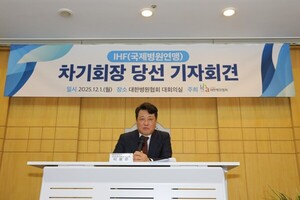
Lee Wang-jun, vice president of the Korean Hospital Association (KHA) and newly elected head of the International Hospital Federation (IHF), said Monday he plans to leverage Korea’s healthcare know-how to connect hospitals across different medical systems and steer global efforts toward addressing aging populations and soaring medical costs through next-generation healthcare technologies including AI.
At a press conference held in Seoul, Lee said being elected as IHF president is not only a personal honor but also recognition of the leadership that Korea’s hospital and medical communities have built in the international arena.
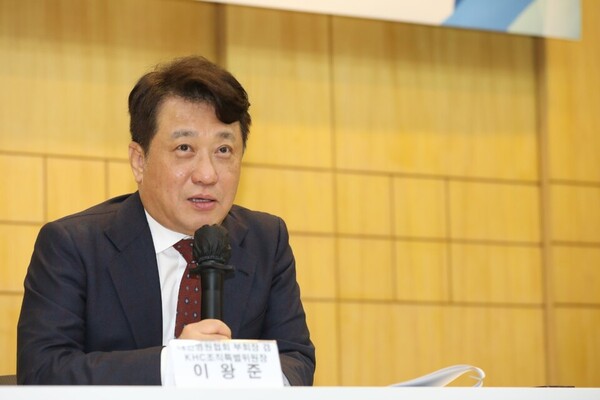
“In the IHF’s 96-year history, there have been only two presidents from Asia, and both are Korean, underscoring the dynamic leadership of Korean healthcare,” he told reporters.
Lee said that he has represented the KHA at the IHF for the past 15 years.
He said, in recent years, the IHF’s cohesion among member states, global stature, and leadership have grown dramatically.
“Interest in and preference for Korea within the international community has surged since Covid-19, which laid an important foundation for hosting the 2026 congress in Seoul and for advancing into the presidential leadership.”
He also revealed plans to build leadership that embraces non-Western countries, positioning the IHF as an international platform capable of addressing common healthcare challenges around the world.
Lee stressed that continuity of leadership is crucial in international organizations.
“I will strengthen the IHF’s roles in education and collaboration, focusing particularly on expanding participation from non-Western countries.” He added, “We will evolve the IHF to be more inclusive of underdeveloped and non-Western countries in Asia and Africa,” noting that “regardless of differences in systems, all countries face common issues such as aging populations, rising healthcare costs, and medical workforce shortages.”
He cautioned that each country’s policies, systems, and infrastructure differ, making it difficult to simply apply or benchmark one national model as is.
However, there are plenty of elements in other countries’ public infrastructures and systems that can be adopted or referenced in ways that fit the Korean context to help address the challenges facing Korean healthcare, he said.
He continued, “Korea has its own unique healthcare system, and within it are highly efficient and innovative elements that other countries find remarkable.” He stressed, “These aspects can, in fact, become strong selling points abroad.”
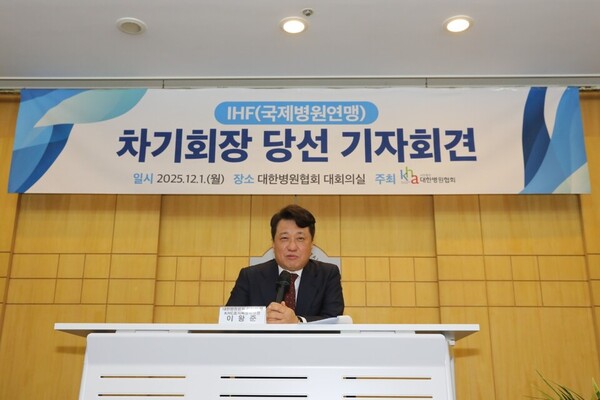
‘IHF will become a hub for global dissemination of AI-backed healthcare’
He also made clear that AI-based hospital management and future technologies will form the core of the IHF agenda. To achieve this, he pledged to carry out the “AI Healthcare Global Action Plan,” which includes: establishing a global AI-healthcare collaborative response platform, creating international guidelines for AI-based hospital operations, and launching the “AI for Access” program to expand AI-driven medical accessibility in underdeveloped countries.
Lee aims to position the organization as a leading force in emerging healthcare technologies, using the AI Healthcare Global Action Plan to act as a central coordinator that speeds the adoption of new tools. He likened the process to drug development, noting that technologies require extensive real-world data and feedback before they can function reliably in clinical environments, much like autonomous vehicles. This approach, he argued, highlights the necessity of an international platform that links these efforts and facilitates broader implementation.
He expressed great anticipation for next year’s World Hospital Congress in Seoul, noting plans to introduce a special session featuring the “Seoul Declaration” on the paradigm of AI-based future healthcare.
Lee said, “With the expansion of the Asian healthcare market, we expect a record number of participants. We will use this opportunity to set a turning point for the globalization of Korean healthcare,” adding, “It will become a symbolic moment for hospitals worldwide to share a new medical paradigm.”
link