Migrant children in Korea 8 times more likely to face healthcare gaps < Policy < Article

Migration experts raised concerns that disparities in health insurance eligibility between nationals and migrants are widening gaps in medical care for children with migration backgrounds. They called for systemic improvements to protect these children’s health rights and reduce their heavy medical cost burden.
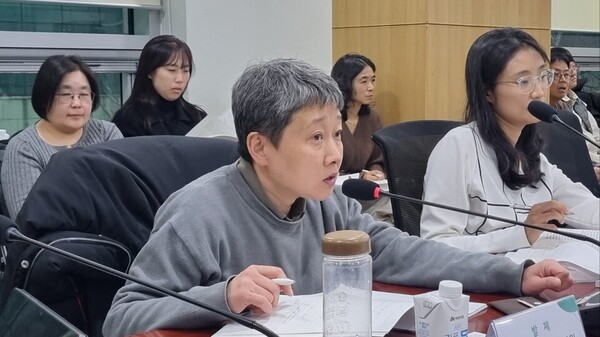
Kim Sa-gang, a research fellow at the Migration and Human Rights Institute, outlined the health insurance coverage gap affecting children from migration backgrounds at the “Policy Discussion Forum on Guaranteeing the Right to Health for Children with Migration Backgrounds,” held on Wednesday.
“While the unmet healthcare rate for Korean infants and toddlers is only 2.4 percent, the rate among migrant infants and toddlers reaches 19.3 percent,” Kim said. The forum was co-hosted by lawmakers from the Democratic Party of Korea, including Reps. Seo Young-kyo, Cha Ji-ho, and Kim Nam-hee, together with ChildFund Korea.
According to the 2024 Survey on the Health Rights of Migrant Infants and Toddlers conducted by Kim, the leading cause of unmet medical needs among migrant infants and toddlers was the burden of medical costs, accounting for 73.7 percent.
This was followed by lack of time (52.6 percent), difficulty communicating with medical staff (36.8 percent), transportation or mobility difficulties (21.1 percent), difficulty choosing a hospital or department (13.2 percent), and fear of exposure of undocumented status or possible enforcement action (7.9 percent).
Since July 2019, enrollment in the national health insurance system has been mandatory for migrants residing in Korea who are registered as foreigners. As of this year, the average insurance premium for migrants stands at 158,630 won ($108) per month.
“Even if they have no income or assets, even if they are too sick to work, or even if they have a disability, they must still pay the monthly health insurance premium of 158,630 won to maintain eligibility,” Kim said. “While minors among Korean nationals are exempt from payment obligations, migrant minors who are heads of households must pay the minimum premium regardless of income or assets.”
She also pointed out that classifying children from migration backgrounds as “unconditional single-person households,” even when they live in grandparent–grandchild households, sibling-only households, or institutional care settings, poses serious problems.
The requirement for migrants to prepay premiums further increases their medical cost burden. Kim noted, “For migrants, insurance benefits are suspended immediately upon delinquency, effective from the first day of the following month. Even if installment payments are approved, benefits remain suspended until the full amount is paid.”
To address these issues, Kim called for expanding the definition of household members to include cohabiting family members; applying the same delinquency rules used for Korean nationals to households that include children and adolescents; allowing minors to enroll in national health insurance regardless of their parents’ residency status or insurance eligibility; granting health insurance coverage to children from migration backgrounds born in Korea immediately after birth; and providing coverage to children arriving from overseas from the moment of entry.
Government officials acknowledged the need to improve medical access for children from migration backgrounds but cited practical constraints, including fiscal sustainability and the need for public consensus.
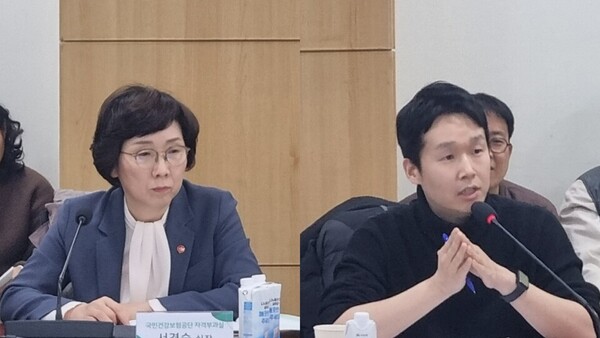
“If social exclusion occurs in guaranteeing basic rights such as children’s health rights, it could lead to negative consequences for society as a whole,” said Seo Kyung-sook, director of the Eligibility Assessment Division at the National Health Insurance Service. “Given the special circumstances of children from migration backgrounds, we will seek improvements through thorough consultation with relevant ministries, based on social consensus.”
Lee Kwan-hyung, director of the Insurance Policy Division at the Ministry of Health and Welfare, said, “While there are many unfortunate cases, it is also true that some foreigners abuse or free-ride on the health insurance system. Forming public opinion and national consensus is critical.”
Lee added, “Even if premiums for foreigners are high, they receive benefits that exceed those costs. Maintaining the same level of benefits while simply lowering the burden is difficult to explain to the public. We hope people can better distinguish between public assistance and social insurance.”
link