[RSNA 2025] GE HealthCare pitches Korea on AI-first cancer and stroke imaging < Device/ICT < Article
![[RSNA 2025] GE HealthCare pitches Korea on AI-first cancer and stroke imaging < Device/ICT < Article](https://cdn.koreabiomed.com/news/thumbnail/202512/29946_32127_3313_v150.jpg "[RSNA 2025] GE HealthCare pitches Korea on AI-first cancer and stroke imaging < Device/ICT < Article")
CHICAGO, Ill. — By Kim Ji-hye / Korea Biomedical Review correspondent — GE HealthCare went to this year’s Radiological Society of North America (RSNA)’s annual meeting with a blunt message for Korean hospitals: if cancer and stroke care are going to keep moving in a world of doctor shortages, the scanners and software will have to do more of the work.
Rajan Kalidindi, chief commercial and strategy officer for ASEAN, Korea and Australia, said the company built its Chicago line-up around that pressure.
GE HealthCare brought nearly 40 imaging and digital products, tying AI-enabled scanners to disease-focused care pathways and cloud platforms aimed at faster, more consistent diagnosis in overloaded systems.
Korea, he said in an interview with Korea Biomedical Review, is both a proving ground and a reference market for how that strategy lands in Asia.
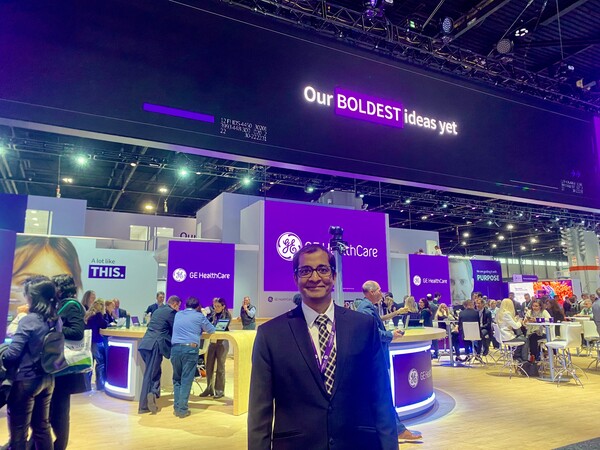
From his vantage point, Korean visitors are no longer treating AI as a curiosity. Executives are asking how automation can ease workforce shortages, cut waiting lists and let tertiary centers support smaller hospitals without simply shifting work onto exhausted staff.
“The questions from customers now cluster into three buckets,” Kalidindi said. “How do we ease workforce shortages and burnout, how do we boost operational efficiency and how do we make collaboration across sites and borders more secure and practical.”
Against that backdrop, GE HealthCare is trying to position its newest scanners as engines for oncology and cardiovascular pathways rather than RSNA showpieces.
For Korea, that story starts with Photonova Spectra, a photon-counting CT that uses energy-resolving detectors to sharpen tissue contrast; the Omni total-body PET/CT, which can image the whole body in a single nuclear medicine exam; and the StarGuide GX digital SPECT/CT, used in oncology and cardiac workups.
Kalidindi pitches the trio as tools to catch cancer earlier, refine stroke and heart-disease decisions and move patients through complex care more smoothly, provided radiopharmaceutical suppliers, academic centers and regulators align on throughput, protocols and reimbursement.
On the MRI and ultrasound side, the workforce story is even more explicit. Korean clinicians who stopped by the booth are asking for help with protocol selection, image reconstruction and repetitive measurements, according to Kalidindi.
Sites using AIR Recon DL, GE’s deep learning–based MRI reconstruction software, are reporting faster scans and improved image quality that help clear backlogs, he said.
OB/GYN teams testing SonoLyst and Hey Voluson, which use AI to assist fetal and gynecologic ultrasound, tell the company that workflows are simpler and exams more consistent from one operator to the next.
Oncology care-pathway software such as CarePath AI is being used to link imaging, reports and downstream decisions across cancer journeys in early adopters, including Korean centers.
Feedback from these pilots is being fed directly into GE’s global roadmap so future RSNA portfolios “increasingly reflect Asia–Pacific needs for speed, accuracy and clinician well-being,” Kalidindi said.
At RSNA, GE also used its SIGNA One, SIGNA Bolt and SIGNA Sprint MRI offerings to show what an “end-to-end AI” day might look like for stretched radiology teams. Pre-scan assistants are meant to reduce variability in how exams are set up, AI-based reconstruction is aimed at faster turnaround, and reading support is designed to standardize reports across junior and senior physicians.
Customers “were enthusiastic about throughput gains and training support, especially for newer staff,” he said, but pressed on who controls AI settings, how tools plug into PACS image archives and RIS radiology IT systems, and what happens to cybersecurity when every scanner is connected.
SIGNA Sprint, in particular, has become an infrastructure story in Korea. Its ventless, low-helium magnet uses a sealed helium design to cut dependence on deliveries and avoid large quench pipes, which reduces the need for structural changes in existing buildings.
For mid-sized hospitals outside Seoul that are short on space, capital and reliable helium supply, GE is framing Sprint as a way to add MRI capacity with lower upfront build-out and faster installation, then layer AI workflows on top to shorten exam times.
Behind the flagship systems sits a quieter fight over the plumbing of imaging and who can access it. Korean hospital leaders are asking for secure, zero-footprint viewing that runs in a browser, embedded AI that does not require separate log-ins and workflow engines that can route studies between sites.
GE is pushing products such as its Genesis Viewer and cloud-hosted AI services as proof that it can “meet customers where they are” by tightening security controls and simplifying integration.
Access still shapes what is possible. Major university hospitals in Seoul and other big cities may already run high-end CT, PET/CT and premium ultrasound systems, but regional and community hospitals often work with older equipment and fewer specialists.
For those sites, Kalidindi said, GE is emphasizing mid-tier CT and ultrasound with embedded AI at more accessible price points, backed by local manufacturing and training models that raise capability without massive capital outlays.
Korean and ASEAN sites that have adopted AI-enabled ultrasound and CT are using them to improve consistency and cut repeat imaging, which he described as “early signals that the gap can be narrowed.”
All of this is playing out against a workforce backdrop that has grown more fragile. Radiology departments worldwide are juggling staff shortages, rising demand and rapid technology change, and Korea’s doctors’ strike turned those pressures into a national issue.
Kalidindi said providers in his region are leaning harder into cloud-based and AI-enabled approaches that turn data into actionable insights, accelerate diagnosis and streamline routine tasks so clinicians can focus on complex decisions instead of box-ticking.
Korea sits at the center of GE’s answer.
Kalidindi described the country as a sophisticated early adopter with strong research capabilities, a dense hospital network and an active imaging and digital health startup scene. GE works with Korean physicians to validate new technologies in real clinical settings and uses those collaborations to shape products that can scale globally.
“Taken together, these factors position Korea not only as an early-adopter market but also as a key hub for research and innovation,” he said, and one GE HealthCare is counting on to drive its precision care story across Asia–Pacific.
link