U.S. Animal Healthcare Packaging Market Size Report, 2033
U.S. Animal Healthcare Packaging Market Summary
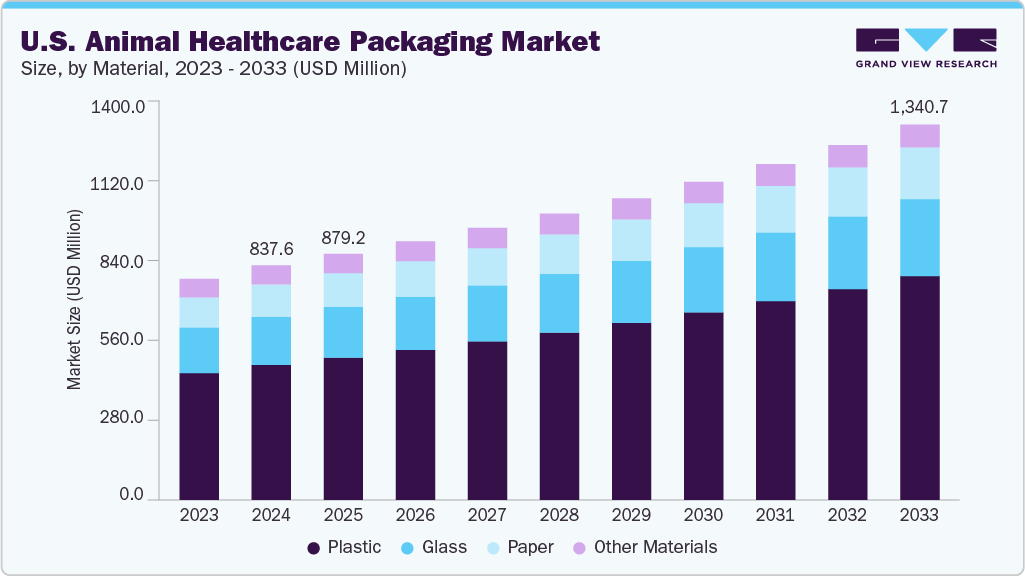
The U.S. animal healthcare packaging market size was estimated at USD 837.6 million in 2024 and is projected to reach USD 1,340.7 million by 2033, growing at a CAGR of 5.4% from 2025 to 2033. The rising pet ownership and demand for advanced veterinary treatments drive the market growth.
Key Market Trends & Insights
- By material, the plastic segment led the U.S. animal healthcare packaging market with the largest revenue share of over 57.0% in 2024.
- By product, the vials segment is expected to grow at the fastest CAGR of 5.9% from 2025 to 2033.
- By animal type, the companion animals segment recorded the largest market share of over 35.0% in 2024.
Market Size & Forecast
- 2024 Market Size: USD 837.6 Million
- 2033 Projected Market Size: USD 1,340.7 Million
- CAGR (2025-2033): 5.4%
Additionally, stringent regulatory standards and increasing investments in pet pharmaceuticals are boosting the need for safe, tamper-evident, and compliant packaging solutions. The U.S. animal healthcare packaging industry is experiencing significant growth, driven by several key factors. One major driver is the rising pet ownership, particularly post-pandemic, with over 66% of U.S. households owning a pet, as per the American Pet Products Association, 2023. This surge has increased demand for pharmaceuticals, nutraceuticals, and veterinary products, necessitating reliable and compliant packaging solutions. For example, child-resistant and senior-friendly packaging for pet medications has gained traction due to stricter FDA regulations and consumer safety concerns. Additionally, the trend toward premiumization of pet care products, including organic and specialty supplements, has led to innovations in sustainable and high-barrier packaging to maintain product integrity.
Another critical factor is regulatory compliance and drug safety standards. The FDA’s stringent guidelines for veterinary drugs and biologics require tamper-evident, leak-proof, and temperature-controlled packaging. For instance, cold-chain packaging for vaccines and biologics (e.g., rabies and canine influenza vaccines) is essential to ensure efficacy. Furthermore, the rise of telemedicine for pets has boosted the need for e-commerce-compatible packaging, ensuring safe transit of medications and supplements ordered online.
Moreover, sustainability concerns are shaping the U.S. animal healthcare packaging market, with pet owners and manufacturers favoring eco-friendly materials. Brands like Hill’s Pet Nutrition and Blue Buffalo are adopting recyclable and biodegradable packaging to align with consumer preferences. Innovations such as mono-material plastic pouches (easier to recycle) and plant-based blister packs are gaining momentum. Additionally, the growth of the livestock sector-driven by meat and dairy consumption-fuels demand for durable, large-scale packaging for vaccines and antibiotics.
Market Concentration & Characteristics
The U.S. market for animal healthcare packaging shows strong innovation, particularly in child-resistant, tamper-evident, and unit-dose packaging. Technologies like smart labels (QR/RFID), cold-chain compatible pouches, and biodegradable blister films are becoming more common. Innovations are driven by the dual need for compliance with FDA/USDA regulations and pet-owner convenience.
Substitution risk is low since packaging is essential for preserving sterility, dosage accuracy, and transport viability. However, bulk dispensing models or alternative delivery systems (e.g., in-feed medication) can reduce packaging demand in specific applications. But for vaccines, oral doses, or pet medications, substitutes are rare.
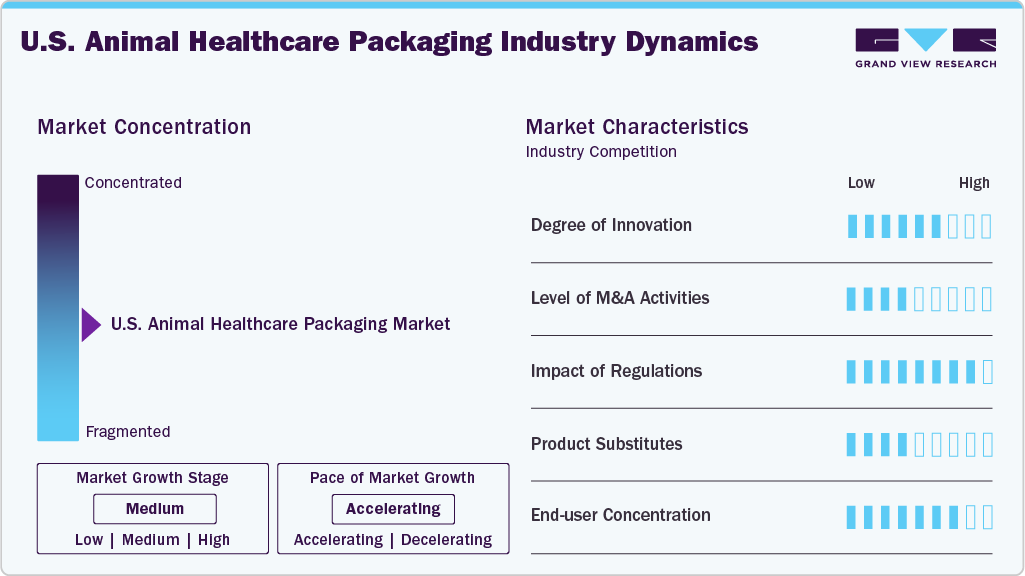
The U.S. animal healthcare packaging industry serves both large-scale clients (e.g., Zoetis, Elanco, Boehringer Ingelheim) and small veterinary clinics or retail chains. There’s a broad customer base-from industrial livestock producers to individual pet owners, meaning no extreme concentration risk, but B2B clients do hold some negotiation power due to volume.
Material Insights
The plastic segment led the U.S. animal healthcare packaging market with the largest revenue share of over 57.0% in 2024 and is expected to grow at the fastest CAGR of 5.8% during the forecast period. Plastic is the most widely used material in animal healthcare packaging due to its versatility, cost-effectiveness, and excellent barrier properties. Common plastic types include polyethylene (PE), polypropylene (PP), and polyethylene terephthalate (PET). Plastic is commonly used in bottles, syringes, blister packs, and vials for packaging veterinary medicines, vaccines, and nutritional supplements. Rising demand for single-dose packaging and increased use of injectable veterinary drugs have further pushed the need for plastic formats.
Glass is primarily used in the packaging of high-value veterinary pharmaceuticals, especially those requiring excellent chemical stability and protection from external elements. It is predominantly used for vials, ampoules, and bottles for liquid injectables, biologicals, and vaccines. Glass provides an inert, impermeable container that maintains the integrity of sensitive compounds. The use of glass is driven by its superior barrier properties, chemical inertness, and ability to protect sensitive animal healthcare products from contamination and UV exposure. Regulatory preferences for glass in biologics and injectable drugs further support its use.
Product Insights
The syringes segment recorded the largest revenue share of over 23.0% in 2024. Syringes in animal healthcare packaging are primarily used for the administration of vaccines, antibiotics, and other injectable medications in both livestock and companion animals. These syringes can be disposable or reusable and are available in various sizes depending on the species and dosage. The rising prevalence of infectious diseases in animals, increased focus on preventive care (like vaccination), and the growing livestock population are driving the demand for veterinary syringes.
The vials segment is expected to grow at the fastest CAGR of 5.9% during the forecast period. Vials are small containers used primarily for storing injectable veterinary drugs, vaccines, and biologicals. They can be made of glass or plastic and often require rubber stoppers and aluminum crimp seals to maintain product sterility. Vials are commonly used in clinical veterinary settings and during mass vaccination drives for livestock. The need for multi-dose storage solutions and temperature-sensitive biologics also supports the growth of this segment.
Animal Type Insights
The companion animals segment recorded the largest market share of over 35.0% in 2024 and is projected to grow at the fastest CAGR of 5.9% during the forecast period. Companion animals include pets such as dogs, cats, rabbits, and other small animals that live with humans for companionship. The packaging used for companion animal healthcare products typically involves syringes, blisters, droppers, pouches, and bottles for vaccines, nutritional supplements, dermatologicals, and oral treatments. As pet humanization increases, there is a growing demand for high-quality, safe, and easy-to-use packaging that reflects the standards of human healthcare. The rising pet adoption rates, increasing spending on pet care, and growing awareness regarding pet health are driving this segment.
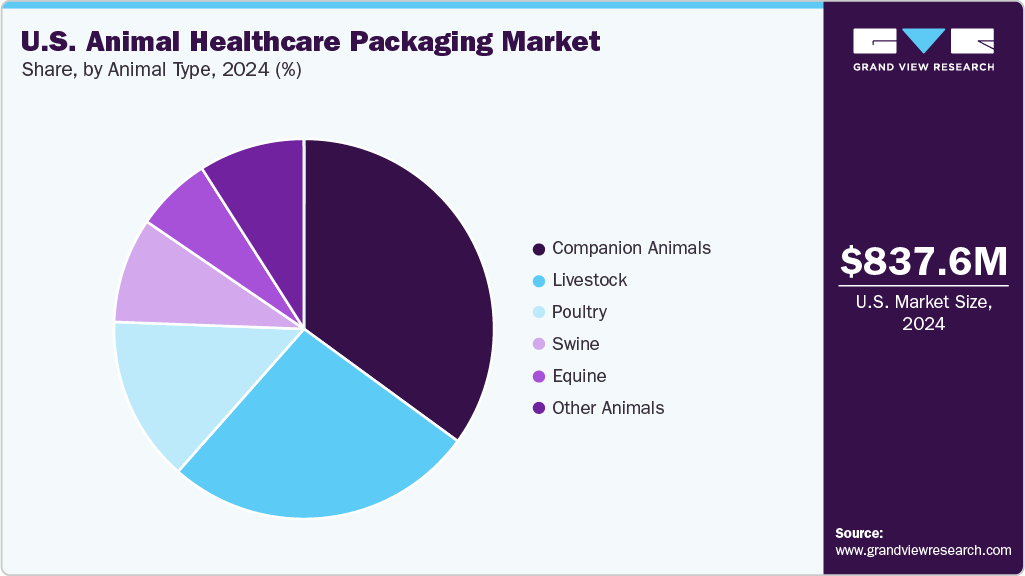
The livestock segment, which includes cattle, pigs, sheep, and goats, raised for meat, dairy, and other agricultural outputs, is a core driver of the animal healthcare packaging market in the U.S. This segment accounts for a significant share of veterinary pharmaceutical consumption, particularly for products such as antibiotics, vaccines, feed additives, parasiticides, and hormonal growth promoters. These products demand robust, bulk-friendly, and often temperature-sensitive packaging formats, such as multi-dose vials, laminated foil pouches, and cold-chain containers. Packaging must meet USDA and FDA standards for hygiene, traceability, and labeling, especially in the case of injectables or products used in food-producing animals.
Key U.S. Animal Healthcare Packaging Company Insights
The competitive environment of the animal healthcare packaging market is characterized by a mix of packaging giants and specialized players competing based on product innovation, regulatory compliance, sustainability, and customization. Major companies dominate the landscape by leveraging their advanced manufacturing capabilities, supply chains, and strong R&D investments to develop sterile, tamper-evident, and eco-friendly packaging tailored for veterinary drugs, vaccines, and nutritional supplements.
-
In April 2023, Virox Technologies, known for its eco-friendly disinfectant chemistries, launched Rescue canister refill wipe pouches aimed at helping animal care professionals clean and disinfect more sustainably. These refill pouches use 90% less plastic compared to traditional wipe canisters and are designed to be inserted into existing Rescue wipe canisters, enabling the reuse of the canisters instead of disposal. Available in a 6-pack format across the U.S., the product reduces packaging waste and is more cost-effective for customers.
-
In February 2023, Nexus Pharmaceuticals launched a new sterile vial product line-including 20mL and 10mL clear vials, and 2mL amber vials-manufactured under GMP in their FDA-inspected Pleasant Prairie, WI facility. Featuring FluroTec Barrier Film and latex-free chlorobutyl stoppers, the vials target research labs, healthcare clinics, and veterinary offices, aiming to ease supply chain issues and expand Nexus’s healthcare reach.
Key U.S. Animal Healthcare Packaging Companies:
- Gerresheimer AG
- SCHOTT AG
- AptarGroup, Inc.
- Nipro Corporation
- TekniPlex Healthcare
- Catalent, Inc.
- Berry Global Inc.
- Borosil Limited
- Nexus Pharmaceuticals, Inc.
- CKS Packaging, Inc.
- Acme Vial & Glass Company
- Pacific Vial Manufacturing Inc.
U.S. Animal Healthcare Packaging Market Report Scope
|
Report Attribute
|
Details
|
|
Market size value in 2025
|
USD 879.2 million
|
|
Revenue forecast in 2033
|
USD 1,340.7 million
|
|
Growth Rate
|
CAGR of 5.4% from 2025 to 2033
|
|
Historical data
|
2021 – 2023
|
|
Forecast period
|
2025 – 2033
|
|
Quantitative units
|
Revenue in USD million, volume in million units, and CAGR from 2025 to 2033
|
|
Report coverage
|
Revenue forecast, volume forecast, competitive landscape, growth factors, and trends
|
|
Segments covered
|
Material, product, animal type
|
|
Key companies profiled
|
Gerresheimer AG; SCHOTT AG; AptarGroup, Inc.; Nipro Corporation; TekniPlex Healthcare; Catalent, Inc.; Berry Global Inc.; Borosil Limited; Nexus Pharmaceuticals, Inc.; CKS Packaging, Inc.; Acme Vial & Glass Company; Pacific Vial Manufacturing Inc.
|
|
Customization scope
|
Free report customization (equivalent up to 8 analyst’s working days) with purchase. Addition or alteration to country, regional, and segment scope.
|
|
Pricing and purchase options
|
Avail customized purchase options to meet your exact research needs. Explore purchase options
|
U.S. Animal Healthcare Packaging Market Report Segmentation
This report forecasts volume & revenue growth at the U.S. level and provides an analysis of the latest industry trends in each of the sub-segments from 2021 to 2033. For this study, Grand View Research has segmented the U.S. animal healthcare packaging market report based on material, product, and animal type:
-
Material Outlook (Volume, Million Units; Revenue, USD Million, 2021 – 2033)
-
Plastic
-
Glass
-
Paper
-
Others
-
-
Product Outlook (Volume, Million Units; Revenue, USD Million, 2021 – 2033)
-
Syringes
-
Bottles
-
Vials
-
Pouches
-
Blisters
-
Cans
-
Others
-
-
Animal Type Outlook (Volume, Million Units; Revenue, USD Million, 2021 – 2033)
-
Companion Animals
-
Livestock
-
Poultry
-
Swine
-
Equine
-
Other Animals
-
link