North Korea’s 2025 Health Revolution
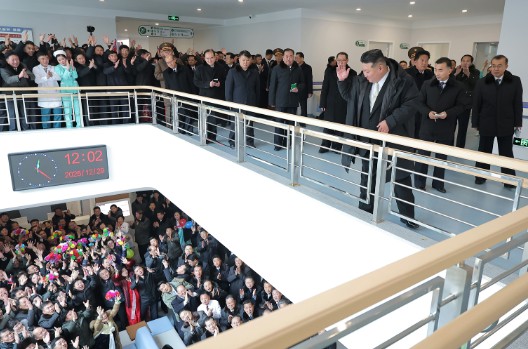
In a significant policy pivot amid ongoing economic sanctions, Kim Jong Un designated 2025 as the “First Year of the Health Revolution,” launching an aggressive campaign to construct modern hospitals in cities and counties nationwide. This initiative is closely linked to the “20×10 policy for regional development,” a core national project launched in 2024 aiming to build modern industrial factories in 20 counties annually over a decade to bridge the widening economic gap between Pyongyang and the provinces.
While the 20×10 policy initially focused on light industry and consumer goods, Kim expanded its scope during on-site guidance in late August 2024, instructing that local health facilities be constructed in tandem with these industrial projects. By February 2025, the regime moved from rhetoric to action, holding groundbreaking ceremonies for pilot projects at Kangdong County Hospital on February 6, Ryonggang County Hospital on February 9, and Kusong City Hospital on February 24. The stated goal was ambitious: to complete these complex medical facilities within a single year. However, this project is not simply about building hospitals. When viewed in the context of recent shifts, it may herald the arrival of a new health policy intended to replace North Korea’s long-nominal universal free healthcare system and its socialist medical structure.
Foundations of the Health Revolution: The End of “Free Healthcare System”?
Prior to the formal declaration of the 2025 Health Revolution, significant rhetorical and administrative shifts were already underway in North Korean health policy. Most notably, the phrase ” Universal Free Healthcare System”—long a hallmark of the regime’s socialist identity and propaganda—has effectively vanished from state media.
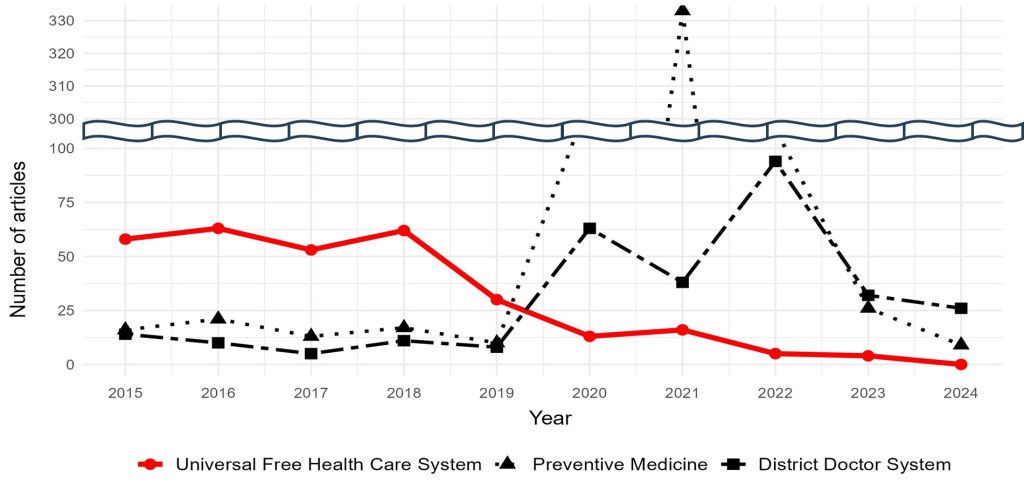
A quantitative text analysis of articles in Rodong Sinmun regarding the three traditional pillars of North Korean healthcare—”Universal Free Healthcare System,” “Preventive Medicine,” and the “District Doctor System”—reveals a stark trend. As shown in Figure 1, the number of articles referencing the UFHCS remained relatively stable from 2015 through 2018, ranging from 53 to 63 per year. However, a decline began in 2019 (30 articles) and accelerated during the pandemic: only 13 articles appeared in 2020, dropping to just five in 2022. By 2024, the phrase had vanished completely. This pattern stands in stark contrast to the trends for the other two pillars of North Korean healthcare—the “District Doctor System” and “Preventive Medicine.” Coverage of these topics surged during the COVID-19 pandemic (2020–2022) and has remained steady since 2023.
This rhetorical erasure appears to be matched by concrete administrative changes. Following the declaration of the end of the COVID-19 crisis in August 2022, the word “People’s” (Inmin) was systematically removed from hospital names. “People’s Hospitals”—a designation that underscored the socialist social contract—were rebranded simply as Provincial, City, or County Hospitals. For North Korea watchers, the removal of this designation, which had existed since the regime’s founding, has drawn attention to potential changes in the free healthcare system. Indeed, reports from inside the country in April 2025 indicated that hospitals had begun officially posting fees at reception counters and charging patients openly.
Furthermore, the state-run “Standard Pharmacies,” which began installation under Kim’s orders in May 2022, were established in all cities and counties by 2024. Notably, these state-operated entities sell medicine for profit rather than distributing it for free.
In this context, Kim Jong Un’s policy speech at the 14th Supreme People’s Assembly 10th Session in 2024 is telling. He instructed officials to ensure that the “health security system based on a health insurance fund, which is being expanded nationwide, is implemented without deviation.” This is noteworthy as it suggests the possibility of a new financing source emerging to replace the existing Universal Free Healthcare System.
The Unfolding Process: Construction, Modernization, and Digitization
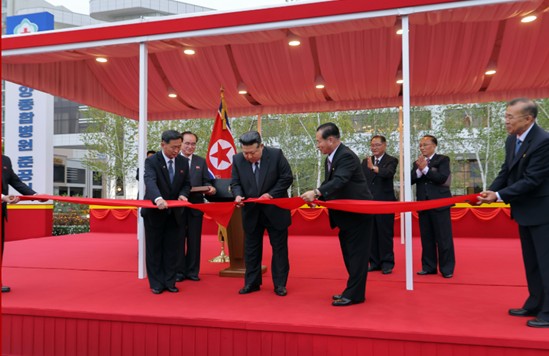
North Korea kicked off its local hospital modernization drive with the Kangdong County Hospital groundbreaking in February 2025. During the ceremony, Kim Jong Un announced that future local hospitals would be categorized into four types based on regional population size, with the pilot projects in Kangdong, Ryonggang, and Kusong serving as models for these varying scales.
Later that month, Kim visited the Pyongyang General Hospital. Although construction began with great fanfare in March 2020 with an October 2020 completion target, the project had faced long delays, becoming a visible symbol of the country’s economic struggles. By revisiting the site in 2025, Kim emphasized its role as a top-tier medical hub and a model for the nation, signaling that the regime was finally ready to operationalize this flagship facility.
To support these new facilities, Rodong Sinmun defined the four essential elements of healthcare as: 1) medical facilities, 2) medical equipment, 3) personnel capacity, and 4) medicine supply. A major emphasis was placed on personnel training, led by central hospitals in Pyongyang. The regime initiated an active rotation of staff, sending experts from Pyongyang to train local doctors and assigning top medical graduates to these new local hospitals. Regarding medicine, the state highlighted the construction of Good Manufacturing Practice (GMP) certified Koryo (traditional) medicine factories. This reliance on “Koryo medicine” highlights the regime’s strategy of utilizing domestic resources to mitigate the chronic shortage of western pharmaceuticals.
Kim also issued directives to modernize the system itself, ordering the digitization of management and services in local hospitals, modeled after the “smart” systems of Pyongyang General Hospital. He called for the establishment of a nationwide healthcare service infrastructure that integrates the entire delivery system—from central hospitals to provincial, city, and county facilities, down to individual households. This likely represents a strategic move to overcome the physical lack of specialists in rural areas by creating a cohesive network. Additionally, he ordered research into placing emergency centers between county hospitals and rural “Ri” (village) clinics to further improve accessibility.
Tangible Results and Political Fallout
By the second half of 2025, tangible results were visible. Pyongyang General Hospital finally held its completion ceremony on October 6 and opened for treatment on November 3. Kim praised the facility as a “hospital-like hospital” and a “people-centered” creation. However, the opening was accompanied by a severe reprimand of the responsible officials. In a scathing rebuke, Kim blamed cabinet officials for the years-long delays, criticizing the Ministry of Public Health for lacking “common sense, concept, and will.” He suggested the need for a separate, more effective organization to lead health initiatives to bypass the bureaucratic inefficiencies of the cabinet. He further ordered fundamental reforms to institutional mechanisms that had become “nominal” despite decades of custom.
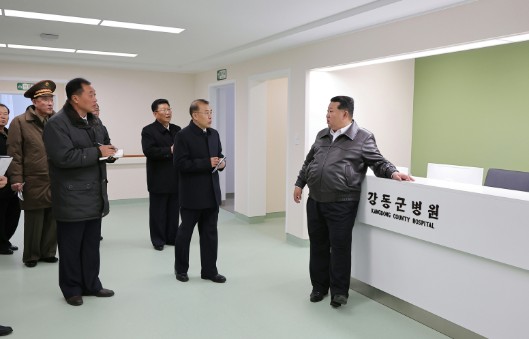
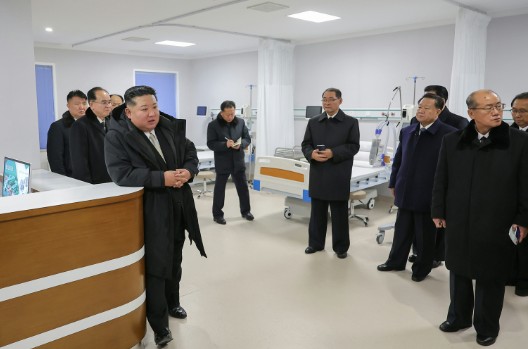
Following this, the completion of the pilot local hospitals was announced in rapid succession: Kangdong County Hospital on November 19, Kusong City Hospital on December 13, and Ryonggang County Hospital on December 29. Both Kangdong and Kusong hospitals officially opened for service on December 31, allowing the regime to claim a victory for the “First Year of the Health Revolution” just before the new year.
Evaluation: Success in Hardware, Questions on Sustainability
North Korea successfully met its stated goals for 2025, opening Pyongyang General Hospital and completing three local pilot hospitals. Achieving this simultaneous construction of factories, health facilities, science and technology centers, and grain management facilities under the 20×10 policy, all while under strict international sanctions, is a notable logistical feat.
However, as Kim Jong Un noted, building a hospital is more complex than erecting a factory; it requires the integration of sophisticated equipment and highly trained personnel. It is unlikely North Korea sourced all necessary resources domestically. The most plausible enabler of this rapid modernization is cooperation with Russia. Since signing a health agreement in 2024, bilateral cooperation has deepened. In March 2025, a working-level delegation from the Ministry of Public Health visited Russia. Furthermore, the Director of the Academy of Medical Science, serving as Chairman of the DPRK-Russia Friendship Parliamentary Group, met with a Russian delegation in April and subsequently visited Russia in October. Reports suggest North Korea is receiving support in medical training and equipment from Moscow.
The true test, however, lies in operational sustainability. Considering the scale of the new hospitals, they require a steady supply of modern essential medicines for inpatient care and surgeries, as well as reliable electricity. Yet, North Korea appears to be relying heavily on traditional Koryo medicine to meet pharmaceutical demand, raising questions about the actual quality of care for serious illnesses. Furthermore, the operational costs—24-hour staffing, maintenance of high-tech equipment, and support for inpatient daily life—are substantial. Without a sustainable funding model, these hospitals risk becoming hollow shells—modern on the outside but non-functional on the inside. Similar concerns have already emerged regarding the 20×10 policy factories, with reports of low operation rates and poor product quality due to power and raw material shortages.
Outlook: The “Simultaneous Parallel Strategy” and the Future of North Korean Healthcare
Looking ahead to 2026, Kim Jong Un has ordered an acceleration of the Health Revolution. The plan includes constructing 20 new city and county hospitals annually, building a second general hospital in Pyongyang, and upgrading provincial hospitals to the central level. To achieve this, he has declared a “Simultaneous Parallel Strategy,” pursuing construction, systemic reform, education, and R&D concurrently. This strategy carries high risks; attempting to overhaul the entire system at once often leads to bottlenecks and quality control issues in the North Korean context.
North Korea has set formidable tasks for itself in 2026. The spotlight is now on how the regime will mobilize the necessary finances and manpower to fulfill these ambitions in meaningful and sustainable ways. Notably, Kim Jong Un has ordered the reform of “institutional mechanisms and organizational systems that have become nominal despite longstanding custom.” It remains to be seen whether a new official financing source will emerge to replace the nominal free medical care system, securing the funds necessary not only for construction but for the sustainable operation of these hospitals. Indeed, recent reports suggesting the introduction of a medical insurance system indicate that such fundamental changes may already be underway.
link