
Cardiac Catheterization: Procedure & Recovery
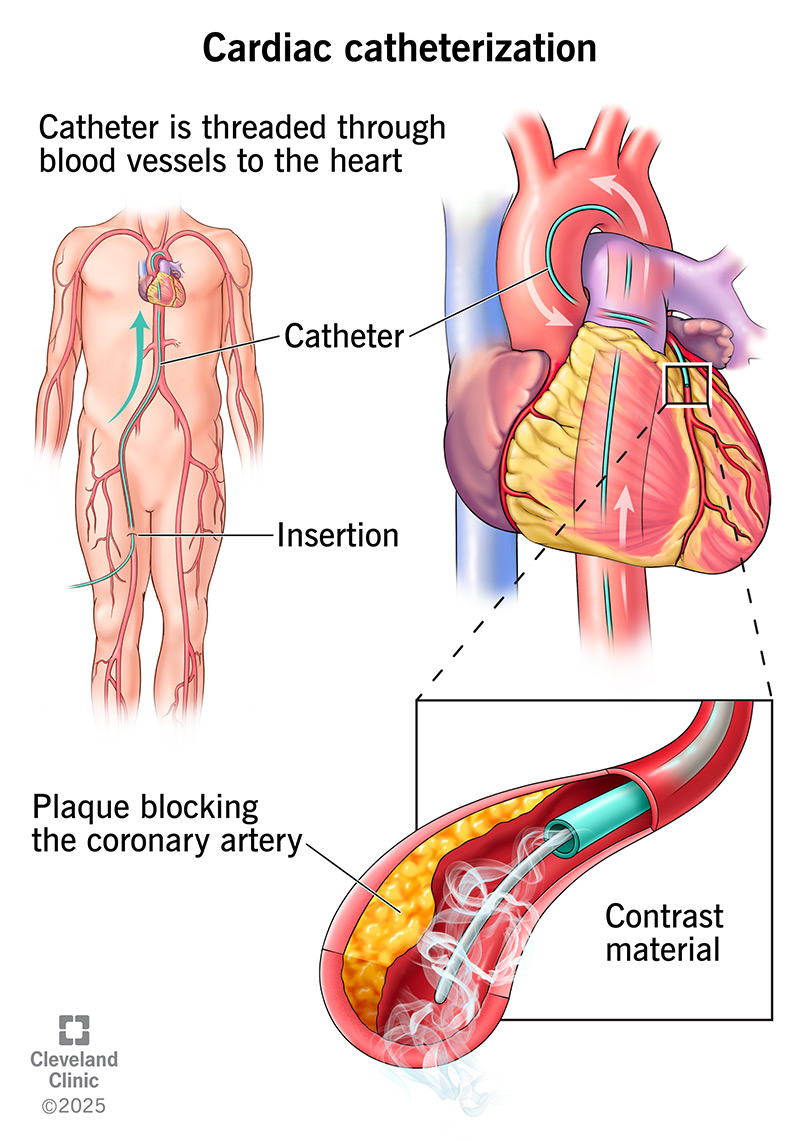
How does cardiac catheterization work?
A provider uses contrast material to outline your vessels and heart chambers in images. They create X-ray movies (coronary angiogram) as the contrast material moves through your heart.
Digital photos of the contrast material allow your provider to:
- Identify the site of the narrowing or blockage in a coronary artery
- Evaluate the size and shape of heart chambers and blood vessels
- Find abnormal leaks or holes
In some cases, your healthcare provider may want to get better detail by using other imaging procedures during your cardiac cath. These may include:
- Intravascular ultrasound (IVUS) to see plaque and calcium buildup or check stent placement
- Fractional flow reserve (FFR) to measure the pressure on both sides of a blockage and see if a blockage is bad enough to need treatment
- Optical coherence tomography (OCT) to take pictures inside blood vessels
Your provider may also want to perform procedures during your cardiac cath. These nonsurgical treatments may include:
- Angioplasty to open narrowed coronary arteries and improve blood flow to your heart
- Stent placement to help an opened artery stay that way
- Valvuloplasty to open a narrow heart valve
- Rotablation to treat calcium deposits in arteries
- Intravascular lithotripsy to break up calcium with pressure waves and a special balloon
- Cardiac ablation to correct an abnormal heart rhythm
How long does a heart cath take?
A heart catheterization procedure that’s just looking at your coronary arteries generally takes 30 minutes. This can take more or less time depending on the goal of the procedure.
But the preparation and recovery time add several hours to your appointment time. It may be five to nine hours or longer. You should plan on staying at the hospital all day for your procedure, even though you’re awake for it. If your providers decide to do an intervention, like an angioplasty, that can take longer — sometimes a couple of hours.
What to expect before the test
Before a cardiac catheterization, you can expect to:
- Stop eating and drinking for several hours (usually six to eight) before your procedure
- Stop or adjust doses of certain medications if your provider tells you to
- Tell your provider about any allergies you have and any medicines you take
Once you arrive, you’ll:
- Change into a hospital gown
- Receive an intravenous (IV) line in your arm for medications and fluids
- Lie on a special table with a large X-ray camera and several TV monitors above it
- Have a provider prepare your skin at the site where they’ll insert the catheter (narrow plastic tube)
- Have a provider place electrodes (small, flat, sticky patches) on your chest. These attach to an electrocardiograph monitor (EKG), which monitors your heart rate and rhythm
- Receive a mild sedative to relax you, but you’ll be awake and conscious during the entire cardiac cath
- Get instructions about what to watch for (allergic reactions, nausea or chest discomfort)
What happens during the test?
During your cardiac catheterization procedure, a healthcare provider will:
- Inject a numbing medicine under your skin with a small needle
- Insert a plastic introducer sheath (a short, hollow tube the catheter goes through) in a blood vessel in your arm, neck or groin
- Insert a catheter through the sheath and thread it to your heart (you may feel pressure when your provider puts in the introducer sheath or catheter, but you shouldn’t feel pain)
- Ask you to turn your head or take a deep breath and hold it for a few seconds to help position the catheter
- Dim the lights and inject a small amount of contrast material through the catheters into your arteries and heart chambers. You may feel hot or flushed for several seconds
- Use an X-ray camera to take photographs of your arteries and heart chambers while the contrast is flowing through them (you may need to hold your breath while your provider takes the X-rays)
- Remove the catheter and sheath while you stay still
- Turn the lights on
What to expect after cardiac catheterization
Your healthcare provider will remove the catheters and sheath after your procedure.
If you had a catheter in your arm for your cardiac cath, you can expect to:
- Have a bandage on the puncture site
- Keep your arm straight for at least an hour (but you’ll be able to walk around)
- Be under observation for a few hours to monitor any symptoms or side effects of the procedure
- Get instructions on how to care for your arm when you go home
- Tell your provider if you think you’re bleeding (wet, warm sensation) or feeling any numbness or tingling in your fingers
If you had a catheter at your groin for your heart cath, your provider will:
- Close your puncture site with applied pressure, and sometimes a suture device or a “plug” that works with your body to form a clot (this reduces the risk of bleeding)
- Ask you to lie flat and keep your leg straight for two to six hours to prevent bleeding (less time if they used a plug) — they’ll also ask you not to raise your head more than two pillows high
- Place a sterile dressing on your groin area to protect it from infection and check it regularly
- Ask you to let them know if you think you’re bleeding (have a wet, warm sensation) or if your toes begin to tingle or feel numb
Cardiac catheterization recovery
For heart catheterization recovery, you’ll:
- Need to drink plenty of liquids to clear the contrast material from your body
- Find out from your provider if you’ll be going home or staying overnight (in either case, they’ll monitor you for several hours after the procedure)
- Talk with your provider about caring for your wound site
- Need to have a friend or family member drive you home (you should stay in a hotel if you have more than a two-hour drive home, and stop every hour and walk for five to 10 minutes)
You can usually drive 24 hours after leaving the hospital. Depending on where the catheter was, you’ll need to avoid strenuous activities (including sports and lifting) for two to five days. Your healthcare provider can tell you when you can return to work.
During your recovery at home, you shouldn’t submerge the puncture site in water for a week. That means no swimming or taking baths. But you may shower 24 hours after the procedure.
What are the risks of this test?
Some of the possible cardiac catheterization risks include:
- Allergic reaction
- Irregular heart rhythm
- Low blood pressure
- Bleeding or infection at the catheter insertion site
- A collapsed lung (pneumothorax)
- Continued chest pain or angina
- Kidney failure
- Cardiac tamponade (fluid buildup around your heart)
- Blood clots, heart attack, stroke or death
- Emergency surgery, like coronary artery bypass graft (CABG) surgery
When you talk with your provider, ask questions to make sure you understand all of the potential risks and why they recommend the procedure.
Although cardiac catheterization isn’t surgery, you may consider it a serious procedure. But people rarely have complications from a heart cath. Providers perform more than one million cardiac catheterizations in the U.S. each year.
link